
Beware the Velvet Ant!!
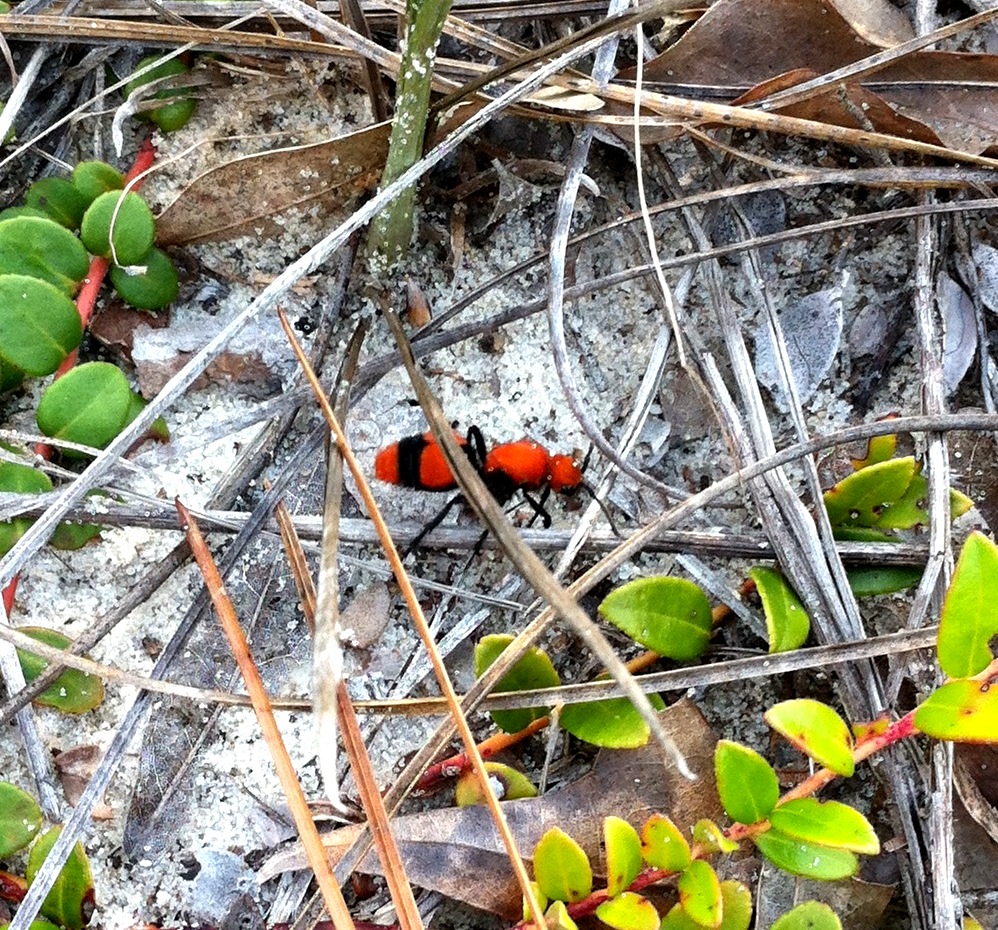 Beware the velvet ant which we have been seeing many of in recent weeks here on the Crystal Coast of North Carolina! Velvet ants, despite their title, aren’t actually ants at all but solitary wasps in the family Mutillidae. These wasps are covered with dense hairs giving them a velvety appearance, hence the name. Velvet ant females are often encountered in open, sandy areas within pasture and turf settings where their larval hosts, ground nesting bees and wasps, are likely to be found. After hunting out underground host nests, the wingless female lays an egg within the larval chamber or on the host larva itself. Upon hatching, the immature velvet ant feeds and develops on the host larva eventually consuming it. The best way to purge an area of unwanted velvet ants is to exclude the ground nesting bees and wasps they are parasitic on. The preferred method is to discourage initial colonization by maintaining a lush, thick turf stand.
As an interesting side note these wasps are often referred to as “Cow Killers” because their sting is alleged to be so painful it could kill a cow! Entomologists developing a sting pain scale ranked the Velvet wasp sting a 3.0 out of a possible 4 (traumatically painful). In this case a 3.0 indicated a “sharply and seriously painful” sting. I think I’ll take their word for it! Fire ants were ranked at a meager 1 for those of you familiar with their sting.
Velvet ants exhibit aposematic or “warning” coloration. Remember when you see an animal that has a combination of yellow and back or red and black it is best to leave them alone!
 parkerbiolabs.com