
Tiphia wasps: Quietly waging war against white grubs

A few weeks ago, while collecting white grubs in the beautiful mountains of North Carolina, I came across a sight which would send a thrill up the leg of many a turf entomologist. As I wiped soil back and forth with my hands to expose cryptic grubs hiding below, throngs of small black wasps emerged. I started to inspect the grubs remaining to insure they were healthy for research trials. I found myself saying repeatedly, “Nope can’t use that one, it’s parasitized”. I quickly realized that about 60% of the masked chafer grubs at this site, literally hundreds of them, were harboring lethal little passengers, larval Tiphia wasps, likely the native species, Tiphia pygidialis.

Adult Tiphia are solitary, medium sized black wasps measuring about a ½ in long. There are many species of native and introduced Tiphia throughout the U.S. which parasitize other larval scarabs, for example Japanese beetles and May beetles. They feed primarily on honeydew from sap-sucking insects as well as nectar from flowers and are completely benign to humans1. In the soil, female wasps locate white grubs by using a combination of the grub’s own body odor and the smell of their frass2 (bug nerd term for insect excrement). Once located, she stings the grub rendering it paralyzed and attaches an egg to its body. The wasp larva, upon hatching, pokes a hole in the grub’s skin and begins feeding, slowly sucking up the bodily fluids until all that remains is the grub’s head and flaccid body! These Tiphia wasps are what we call parasitoids since their feeding activities kill their hosts, unlike parasites (e.g. fleas, ticks and lice) which leave their hosts alive. On a side note, were you aware that the 1979 Sci-fi horror film Alien is based on parasitoids?
Some of the most recent research concerning Tiphia spp. was conducted in the lab of Dr. Dan Potter at the University of Kentucky by his former PhD student and now professor at the University of Florida, Michael Rogers. This research characterized the biology and ecology of two species of Tiphia and focused on ways in which turfgrass managers may help encourage parasitism. One study found that planting nectar-producing flowers, particularly peonies, into a turf setting can significantly boost parasitism rates by the spring Tiphia, Typhia vernalis, a species introduced from Asia that specializes in taking-out the dreaded Japanese beetle grub3.
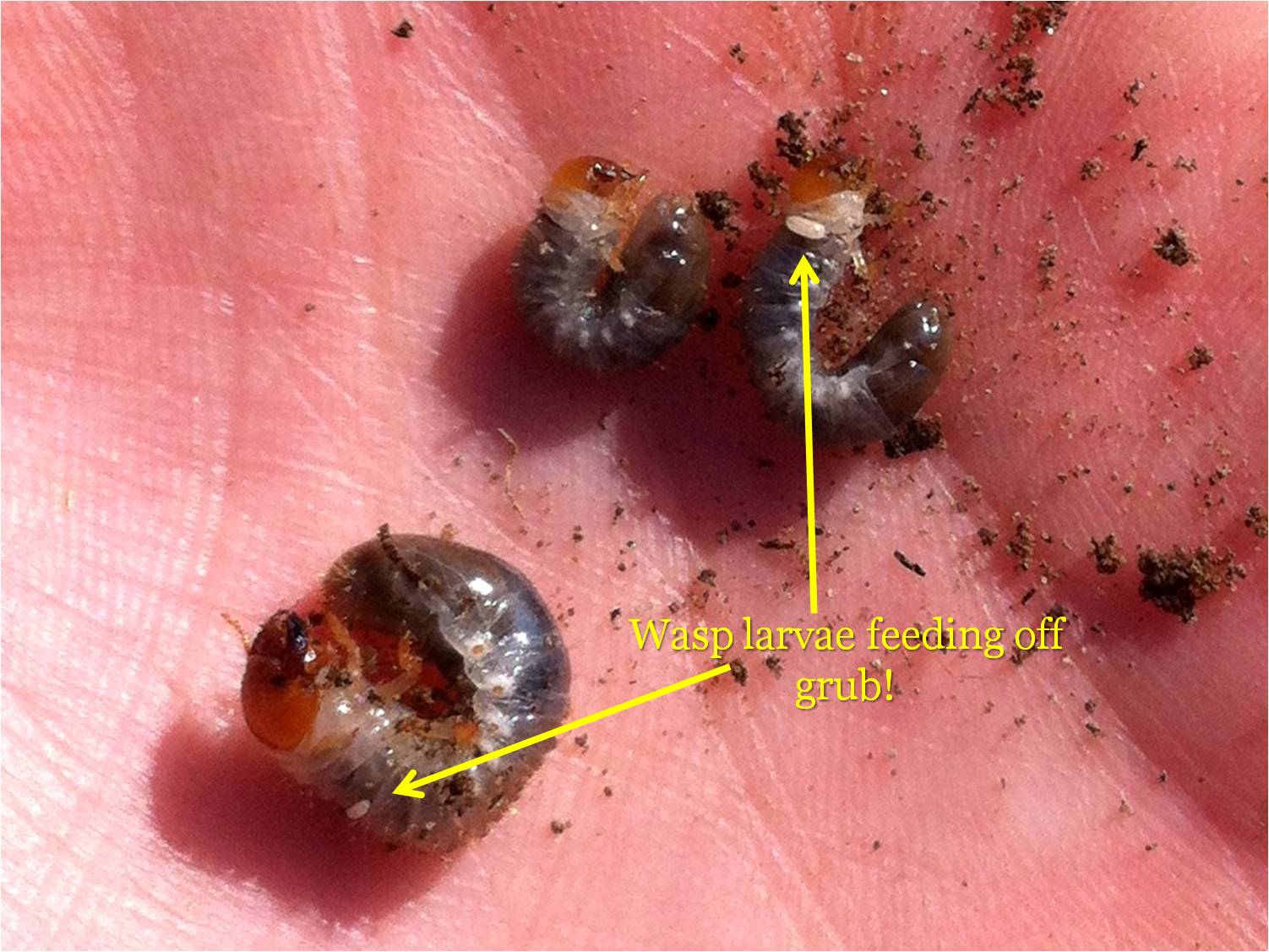
While parasitism rates of 60% by Tiphia are likely the exception not the rule and while protective chemicals are of course still necessary to insure grub-free grass, it is nice to recognize that there are in fact small minions of Mother Nature fighting the good fight and on your side in the battle against white grubs.
For more on Tiphia wasps and the research conducted in the Potter lab see http://gsr.lib.msu.edu/2000s/2002/021109.pdf
Literature Cited
1Potter, D.A. 1998. Destructive turfgrass insects: Biology, diagnosis, and control. Ann Arbor Press, Chelsea, MI.
2Rogers, M.E. and D.A. Potter. 2002. Kairomones from Scarabaeidae grubs and their frass as cues in below-ground host location by the parasitoids Tiphia vernalis and Tiphia pygidialis. Entomologia Experimentalis et Applicata. 102: 307–314.
3Rogers, M.E. and D.A. Potter. 2004. Potential for sugar sprays and flowering plants to increase parasitism of white grubs (Coleoptera: Scarabaeidae) by Tiphiid wasps (Hymenoptera: Tiphiidae). Environmental Entomology 33(3): 619–626
 parkerbiolabs.com