
And Then There Was One
It may be hard to believe in this day and age, but there still exists a certain turfgrass insect pest for which we have no viable management recommendations! If you are unfamiliar with the tiny troublemaker ground pearl, also known pearl scale, then count yourself lucky!
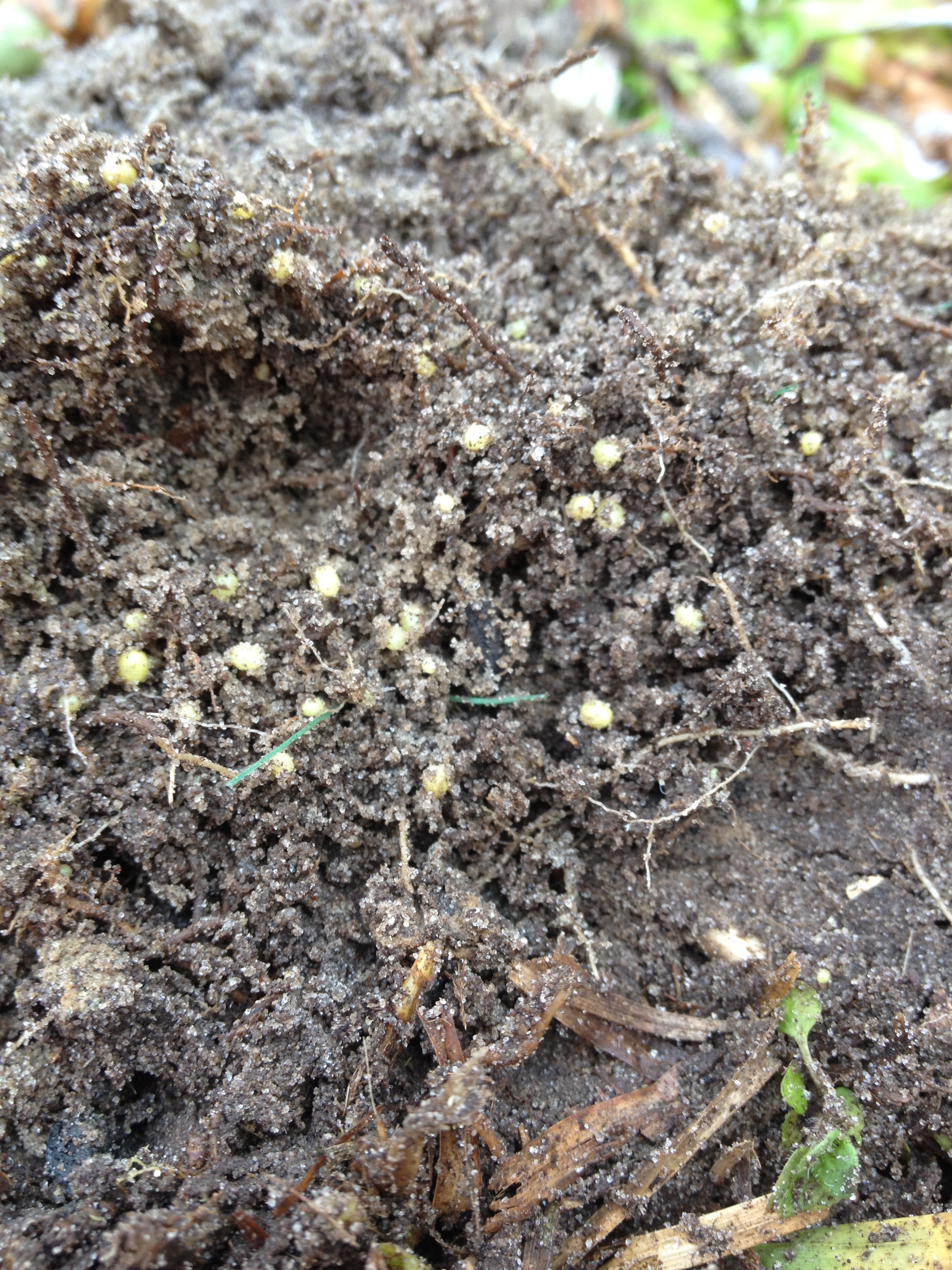
Ground pearls are a type of scale insect that infests roots of warm season turfgrass throughout the southern ranges of the US. Ground pearls earned their name from the protective covering they secrete which encapsulates the immature and adult stages, giving them a pearl-like appearance. Ground pearls are known to attack all warm-season grasses but are most common on centipedegrass, bermudagrass, zoysiagrass and St. Augustinegrass. Centipedegrass and bermudagrass are considered the most susceptible to ground pearls.
Ground pearls, although considered sporadic, are devastating where they occur, killing plants by sucking juices from the roots and leaving only weeds and bare soil in their wake. It has been suggested that ground pearls also inject toxins into plant roots to ease feeding which in turn hastens the death of the plant. Ground pearls are like a cancer, spreading slowly (only a few inches) each year from the point of infestation. No chemicals have proven effective for ground pearls and even worse, turf that is replanted either from sod, seed or sprigging, fails to grow in previously damaged areas. It is only a matter of time before they overtake an entire site!
The key to ground pearl control likely resides in targeting the most susceptible life stages. Ground pearls overwinter in the immature (nymph) stage encased in a pearl-like protective nodule. In late spring, adult females emerge and migrate ~2–5 inches through the soil using a pair of strong claw-like forelegs. In some cases, females will travel to the soil surface and mate with winged gnat-like males; they do not require males to produce viable eggs. The female will then fashion a tube or egg-sac out of waxy material in which she deposits roughly 100 eggs. Most of these egg masses are found within 2–3 inches below the soil surface. Within 2 weeks eggs hatch into crawlers, the first nymphal stage. Crawlers seek out and settle onto healthy turfgrass roots. Once settled, the crawlers stick their sucking mouthparts into rootlets to feed and subsequently secrete their protective pearl-like covering. As the nymph feeds and molts its protective shell will continue to grow.

There are several reasons as to why ground pearl management is incredibly challenging. The foremost reason is their protective pearl-like enclosure in which they spend the majority of their lives. This shield-like coating serves as a barrier to chemical insecticides and prevents them from losing water or dessicating during long periods of drought. Ground pearls are said to be able to survive multiple years of dry periods as well as in the absence of food. They also may be found a foot deep in the soil making chemical contact of an entire population challenging. This also means attempts to remove the first several inches of soil will not get rid of the pest!
Over the next few years we will be working to better understand the biology and ecology of ground pearls in eastern North Carolina. Studies to ascertain susceptible life stages and their timing will be included as well as screening newer pesticides. Stay tuned and we look forward to sharing our progress!
Selected Reference
Hoffman, E. and R. L. Smith. 1991. Emergence and dispersal of Margarodes meridionalis (Homoptera: Coccidae) in hybrid bermudagrass. J. Econ. Entomol. 84: 1668- 1671
 parkerbiolabs.com