
Get a Jump on Turf Pests; Don’t Let Them Get the Jump on You!
During these cold winter months, most turf pests are snug as a bug in their respective over-wintering spots slumbering away, waiting for warming temperatures that beckon spring. For white grubs, its 2-10 inches below the soil surface, curled up in earthen cells, dreaming of tender spring root-growth. Chinch bugs and billbug adults are “chilling” in thatch or in leaf litter areas surrounding turf, hoping it will warm up just enough to stretch a little. Many turf caterpillars, like the fall armyworm, are the “snow birds” of the turfgrass insect world. They have been spending their winter feeding, fattening up, and relaxing in the sunny south biding their time, waiting to hitch a ride up north on a balmy jet stream or warm spring storm fronts. The way in which these insects are spending winter ensures that they are out of sight and most certainly out of mind for many turf managers. This time of year is the perfect opportunity to prepare and get a jump on these pests before they get the jump on you later in the growing season! Below are a few steps you can take now to set up for success!

Look at History
In the mid 1700’s, British philosopher Edmund Burke stated, “Those who don’t know history are destined to repeat it.” He easily could have been referring to turf insect management. Having a superintendent show me their perennial problem areas is one of the first steps I take when developing a management plan for a course. Insects are creatures of habit and are likely to show up and damage the same area year after year after year. Why is this? Particular areas of turf have the right combination of factors that enable insects to flourish. For example, white grubs do well in low-lying spots, particularly those with soil types that hold adequate soil moisture. These areas sustain embryonic development of grubs during the egg stage and support survival when grubs are smaller and subject to desiccation or drying out. Similarly, mole cricket infestations are a chronic problem in areas conducive to development. Female mole crickets choose mates based on the sound of the call they make from deep within their mating burrow. Male cricket calls will differ depending on soil moisture level. The better the soil moisture, the better the sound of the call to a female; one thing leads to another and voila, you have dozens of young mole crickets tunneling up your turf in no time. Take a day to map out historical problem areas and you will be able to forecast future trouble spots!
Know Thy Grass
Another factor to consider are the grass types being managed. It is easy to predict which insect foes you may face when you have this key piece of information. Most insects have their preferred host plants. For example, here in coastal NC if you are managing St. Augustine it’s almost a sure bet you will run up against the southern chinch bug at some point. If you are in the Northeast and new to managing Poa, (yes annual bluegrass, a hard concept for us in the south to grasp) you better prepare yourself for the annual bluegrass weevil! If you’re managing bermudagrass in the coastal Carolinas right now you should be on the lookout for the bermudagrass mite who feeds exclusively on Cynodon spp. There are also mites specific to zoysia, buffalograss, and St. Augustine!
Whether or not a certain insect species make an appearance will not only depend on turf type but also their distribution (i.e. where they occur throughout the country, your state or province). The new Handbook of Turfgrass Insects has updated distribution maps so you may check and see if a given pest occurs in your area. Once you know which pests to expect you can determine how to monitor and recognize early symptoms of an infestation.
Decide When and How You Monitor
Once you have considered the steps above you will have a good handle on which insects will strike and where. Now we need to focus on when they will strike and how to setup an early warning system. Managing turfgrass insects can be tricky as they are cryptic and nearly impossible to kill once big enough to make their presence known. As mentioned previously, white grubs and mole crickets are subterranean and young instars and nymphs respectively, can feed for weeks undetected before the turf shows symptoms. Likewise young billbugs are wrapped up in leaf sheaths or in crowns, concealed from watchful eyes. Even large hoards of roaming armyworms are difficult to detect; not surprising when you consider they are only about 2mm long after hatching. Others for example, cutworms and sugarcane beetles, remain concealed by day and only unveil themselves at night when they have the cloak of darkness to protect them.
The first step in setting up your early warning system is thinking about the life cycle of each pest you are likely to encounter. Ask yourself three questions:
1) Which life stage is easiest to monitor?
2) When, in general, will this life stage appear?
3) Which life stage is easiest to control?
For white grub species (i.e. Japanese beetle, masked chafer, May beetle, green June beetle, European chafer) the adult stage is the most observable. Likewise, our caterpillar pests are also most obvious and easily surveyed during the adult (moth/butterfly) stage. Turf entomologists are not big on giving calendar spray dates mainly for the reason that insect growth and activity are regulated by environmental factors such as temperature and rainfall events. However, having a general knowledge of when these “easily observable” stages are active will help you in your monitoring efforts. Example, in North Carolina Japanese beetle adults generally become active in late May and early June. By deploying a sex pheromone trap around this time you can determine when flight has begun and, once the trap becomes full, peak flight is occurring. We will get back to why this is important in a moment. Pheromone traps and blacklight traps are useful in monitoring day and night flying beetles respectively. Black light traps are also useful in monitoring nocturnal black cutworm and fall armyworm moths. In their northern range cutworms commonly appear in March while fall armyworms tend to make their appearance later in summer. Adult mole cricket activity beings in early spring and can be monitored by observing tunneling activity, using black light traps, or calling traps. Trapping adults or the most observable stage now leads us to our third question mentioned above and why determining peak adult activity is important. The majority of turf insects are most susceptible to insecticides and easiest to control when they are youngest which is immediately after they have hatched from an egg. Early larval and nymphal stages often occur just a few weeks after peak adult activity. By studying the history of infestations and having a general knowledge of life stages one can easily monitor adult presence to target the most vulnerable stage. Now is the perfect time to acquire traps and mark on your calendar the periods of time to when you will begin your scouting activities.
Making Changes that Encourage Pests
Believe it or not, changes that you make this growing season could in fact encourage the establishment of certain turf insect pests. For example, fall armyworm tends to favor newly seeded and sprigged areas or areas with newly laid sod. Changes that lead to the disturbing of soil are often encouraging to fire ants and may lead to new mounds in those areas. A change in grass species may invite a new complex of pests that were restricted or performed poorly on the previous non-host species. Thinking of switching to a cheaper, organic fertilizer? Be careful, studies have shown some organic fertilizers are exceedingly tempting to insects like the green June beetle and black turfgrass ataenius. Remember making even the smallest modifications, such as changing mowing height or altering irrigation and fertilization regimes can have effects that will ripple throughout the system you are managing and impact the guild of insect pests you face.
Getting Down to Brass Tax
It is probably a good idea now to reflect on how much damage you are willing to take from the insects you may deal with later this year. Better to have a plan in place now then scramble and research bugs of all things when there’s a major tournament going on or acres of sod orders to fill! First decide what is acceptable for your unique situation. These are called action thresholds and they will differ depending on utility of the turf, safety of end users, and of course the almighty dollar. If you are managing Augusta and it’s the end of March you may have a zero tolerance policy toward those cutworms on the tees and green plus the budget to back it up. Similarly if you are managing local soccer fields for Parks and Rec you may have a zero tolerance towards fire ants, especially with that toddler tournament next weekend. If you’re managing a sod farm you can probably rest easy at the thought of a few grubs, ignore those cutworms, and of course earthworms are your friend but fall armyworms will need swift and decisive action, an immediate and lethal response. Think about which insects you face and prioritize how you will handle each and know when to take action.
Plan Your Response
The final step in your insect pre-planning is to decide which type of management approach you want to take. For the given insect foes you face, are there cultural controls that you can implement that will save you money and are more environmentally benign? More often than not, proper turfgrass management will enable plants to withstand an insect siege. For instance, chinch bug infestations are often encouraged by frequent applications of nitrogen fertilizers. White grub outbreaks are exacerbated by drought conditions that can be alleviated with frequent watering. Planning is also needed if your strategy involves a chemical response. Which chemicals will you use? Gone are the days of the broad spectrum “smoke-check” every pest you face products. Today’s insecticides are highly selective and activity will differ among pest insects. It is also important to think about how many generations a certain pest will have throughout the growing season so insecticide resistance is avoided. Chinch bugs and annual bluegrass weevil are probably the two insects that come to mind when discussing insecticide resistance although others have exhibited cases of resistance. The faster an insect can get through a life cycle the more generations per year it is able to have. When exposed to the same insecticide repeatedly, the proportion of resistant individuals increase until insecticide failure occurs. The number of generations per year for a given pest will not be the same for every state or even geographical area within a state. For example, the number of generations for the southern chinch bug will be much higher in south Florida and Texas due to the tropical climate and continued growing conditions than the number of generations in North Carolina. If you are dealing with an insect that exhibits multiple generations per year, plan now how you will rotate your chemicals. Remember you will want to rotate insecticides that have different modes of action. Need help remembering what those are? Check out this useful link here from the Insecticide Resistance Action Committee (IRAC).
Let’s Recap
Remember, take a day to drive around your course, sod farm, etc. and map out historic problem areas. Try to keep track of when and where insect outbreaks are occur. Consider what type of pests you are likely to face given the turf you manage and where you are located. Figure out when you will start monitoring for each pest/stage and how best to monitor. Mark that down! Think about how the changes you have planned may impact the insects you deal with. Will these changes exacerbate potential pests or help to alleviate them? Reflect on how much and what type of turf injury you are willing to accept and of course what your response measures will be if you are not. Taking a small amount of time to implement these six quick and easy steps now will save you from headaches later and help you get out in front of these turf insects when things really get going this growing season. And if you have any questions or concerns or become overwhelmed in your pre-op planning just remember we are a short phone call away!
it’s winter but Don’t Let those “Tick checks” slide!
During the winter months in the coastal Carolinas, temperatures often fluctuate between what I consider flip flop and duck boot weather. Yet even on our colder days, ticks can still be found actively searching for hosts (that’s us)! In fact the Lyme disease vectoring black-legged tick, or deer tick as it is commonly called, is not killed by freezing temperatures and is in fact quite active above 35ºF. Already this winter I have pulled several off the kids and dog. Keep up those tick checks, bottle – label with the date – and toss in the freezer any you remove and continue reading below to learn more about the ticks commonly found in our area.

Four tick species are endemic to North Carolina: the lone Star tick, black-legged tick (commonly known as the deer tick), American dog tick, and brown dog tick. Ticks undergo 4 life stages: egg, larva, nymph and adult. With the exception of the egg stage, all forms must take a blood meal to pass onto the next and complete development. Check out the CDC’s tick life cycle page here. Host preference will differ among species and even within stages of the same species (Table 1). Ever wonder how such a small thing like a tick is able to hitch a ride so effectively? Many tick species employ a host-seeking behavior called “questing”. In this ambush-like process, the tick will scamper up vegetation such as weeds and tall grass and outstretch its forelegs once proper cues are received. These cues may include vibrations, host-specific odors (like those from sweat), carbon dioxide, heat and many others. As the host passes the tick latches on with its forelegs quickly and proceeds to a feeding site. The tick then inserts its mouth parts, which are serrated much like a steak knife, into the host and simultaneously secretes a cement-like fluid which helps anchor it to the skin. These two factors explain why it is quite difficult to remove a tick with its head still entact! The tick feeds until engorged and then drops off the host. In addition to the cement-like fluid, tick saliva also contains proteins that aid in feeding and can on occasion cause severe allergies and even paralysis.
Ticks are capable of carrying and transmitting (also called vectoring) disease organisms that cause Lyme Disease, Rocky Mountain Spotted Fever (RMSF), and Ehrlichiosis. Lyme disease is caused by a bacteria and vectored by lone star and black-legged ticks. Progressive symptoms of Lyme Disease include a bulls-eye rash surrounding the bite and flu-like symptoms (within 1-2 weeks), neurological and cardiac problems, and arthritis. Some symptoms may manifest or persist years after the initial tick bite! Rocky Mountain Spotted Fever is caused by a pathogen called a Rickettsia and vectored by the American dog tick. Fever, nausea, muscle ache, joint pain and headaches are symptoms of RMSF that become apparent usually within a week. A rash of small pink dots on the hands and feet develop in most patients and may spread to cover the entire body. This is a VERY IMPORTANT sign that points to infection by RMSF. Death can occur from RMSF so timely treatment is essential. Erlichia bacteria are the causal agents of Erlichiosis, a disease similar to RMSF with symptoms including fever, head and muscle aches, as well as joint pain. Erlichia bacteria are transmitted by the lone star tick and black-legged tick.
Table 1

If heading out to this weekend to an area that may be tick infested, be sure to apply a commercial repellent and check your body and clothing after your outdoor activities. Also be sure your canine pals are properly treated and inspect them frequently as well. If a tick is found, be sure to remove it as well as its mouth parts using your finger or tweezers (never cleaning fluids or a lit match!!!). Always place the tick in a container (vial of alcohol preferably) and mark the date on your calendar. This will help a doctor correctly diagnose any disease you may have been exposed to if symptoms arise. Remember most symptoms manifest with 7-14 days after the tick bite. Ticks can be managed in high risk areas by frequent mowing of vegetation to make habitat unsuitable. Pesticides may also be applied; be sure granular formulations are properly watered in and liquid treatments provide uniform coverage down to the soil surface. Check the North Carolina Ag Chemicals Manual for pesticide recommendations concerning tick management. If you are outside of NC or would like more information, please check with your local extension agent!
For more information on ticks in North Carolina check here
For national information on ticks please see the CDC website here
Be sure to check out more of Alex Wild’s photography here
Handbook of Turfgrass Insects 2nd Edition Now Available!
 The Entomological Society of America’s 2nd edition of the Handbook of Turfgrass Insects is now available for purchase! This edition comprises chapters written by over 30 of the top turf entomology experts throughout the country from both academia and industry. Biological information and photos as well as distribution maps and management tips for traditional pests (imported fire ants, white grubs, billbugs, caterpillar pests, annual bluegrass weevil, mole crickets and many more) have been revised to bring you the most up-to-date information available. Chapters concerning novel and emerging pests such as the European crane fly, sugarcane beetle, mound building ants and others have also been added to this edition. Readers will be pleased to find sections regarding practical insecticide use and resistance management in the turfgrass system. This handbook is designed to give quick and easy access to the most relevant information needed to make cost effective and environmentally sound management decisions. This handbook is ideal for turfgrass managers, Master gardeners, extension personnel, teachers, etc. Each chapter also contains references from scientific literature which makes it ideal for students in turf management and those that desire to learn the science behind it.
Get your copy here today http://www.apsnet.org/apsstore/shopapspress/promos/20944ESA.aspx
Tiphia wasps: Quietly waging war against white grubs

A few weeks ago, while collecting white grubs in the beautiful mountains of North Carolina, I came across a sight which would send a thrill up the leg of many a turf entomologist. As I wiped soil back and forth with my hands to expose cryptic grubs hiding below, throngs of small black wasps emerged. I started to inspect the grubs remaining to insure they were healthy for research trials. I found myself saying repeatedly, “Nope can’t use that one, it’s parasitized”. I quickly realized that about 60% of the masked chafer grubs at this site, literally hundreds of them, were harboring lethal little passengers, larval Tiphia wasps, likely the native species, Tiphia pygidialis.

Adult Tiphia are solitary, medium sized black wasps measuring about a ½ in long. There are many species of native and introduced Tiphia throughout the U.S. which parasitize other larval scarabs, for example Japanese beetles and May beetles. They feed primarily on honeydew from sap-sucking insects as well as nectar from flowers and are completely benign to humans1. In the soil, female wasps locate white grubs by using a combination of the grub’s own body odor and the smell of their frass2 (bug nerd term for insect excrement). Once located, she stings the grub rendering it paralyzed and attaches an egg to its body. The wasp larva, upon hatching, pokes a hole in the grub’s skin and begins feeding, slowly sucking up the bodily fluids until all that remains is the grub’s head and flaccid body! These Tiphia wasps are what we call parasitoids since their feeding activities kill their hosts, unlike parasites (e.g. fleas, ticks and lice) which leave their hosts alive. On a side note, were you aware that the 1979 Sci-fi horror film Alien is based on parasitoids?
Some of the most recent research concerning Tiphia spp. was conducted in the lab of Dr. Dan Potter at the University of Kentucky by his former PhD student and now professor at the University of Florida, Michael Rogers. This research characterized the biology and ecology of two species of Tiphia and focused on ways in which turfgrass managers may help encourage parasitism. One study found that planting nectar-producing flowers, particularly peonies, into a turf setting can significantly boost parasitism rates by the spring Tiphia, Typhia vernalis, a species introduced from Asia that specializes in taking-out the dreaded Japanese beetle grub3.
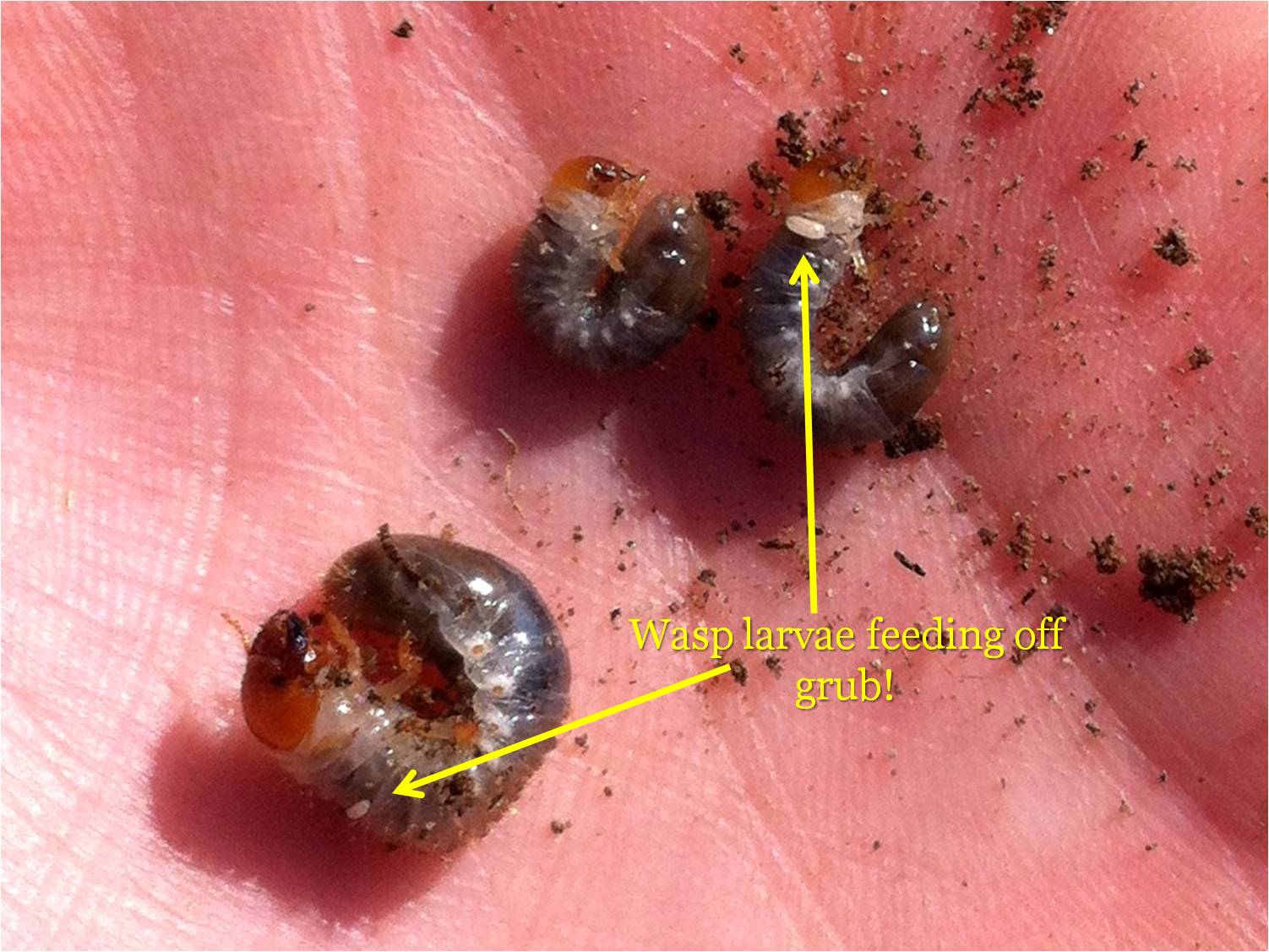
While parasitism rates of 60% by Tiphia are likely the exception not the rule and while protective chemicals are of course still necessary to insure grub-free grass, it is nice to recognize that there are in fact small minions of Mother Nature fighting the good fight and on your side in the battle against white grubs.
For more on Tiphia wasps and the research conducted in the Potter lab see http://gsr.lib.msu.edu/2000s/2002/021109.pdf
Literature Cited
1Potter, D.A. 1998. Destructive turfgrass insects: Biology, diagnosis, and control. Ann Arbor Press, Chelsea, MI.
2Rogers, M.E. and D.A. Potter. 2002. Kairomones from Scarabaeidae grubs and their frass as cues in below-ground host location by the parasitoids Tiphia vernalis and Tiphia pygidialis. Entomologia Experimentalis et Applicata. 102: 307–314.
3Rogers, M.E. and D.A. Potter. 2004. Potential for sugar sprays and flowering plants to increase parasitism of white grubs (Coleoptera: Scarabaeidae) by Tiphiid wasps (Hymenoptera: Tiphiidae). Environmental Entomology 33(3): 619–626
Beware the Velvet Ant!!
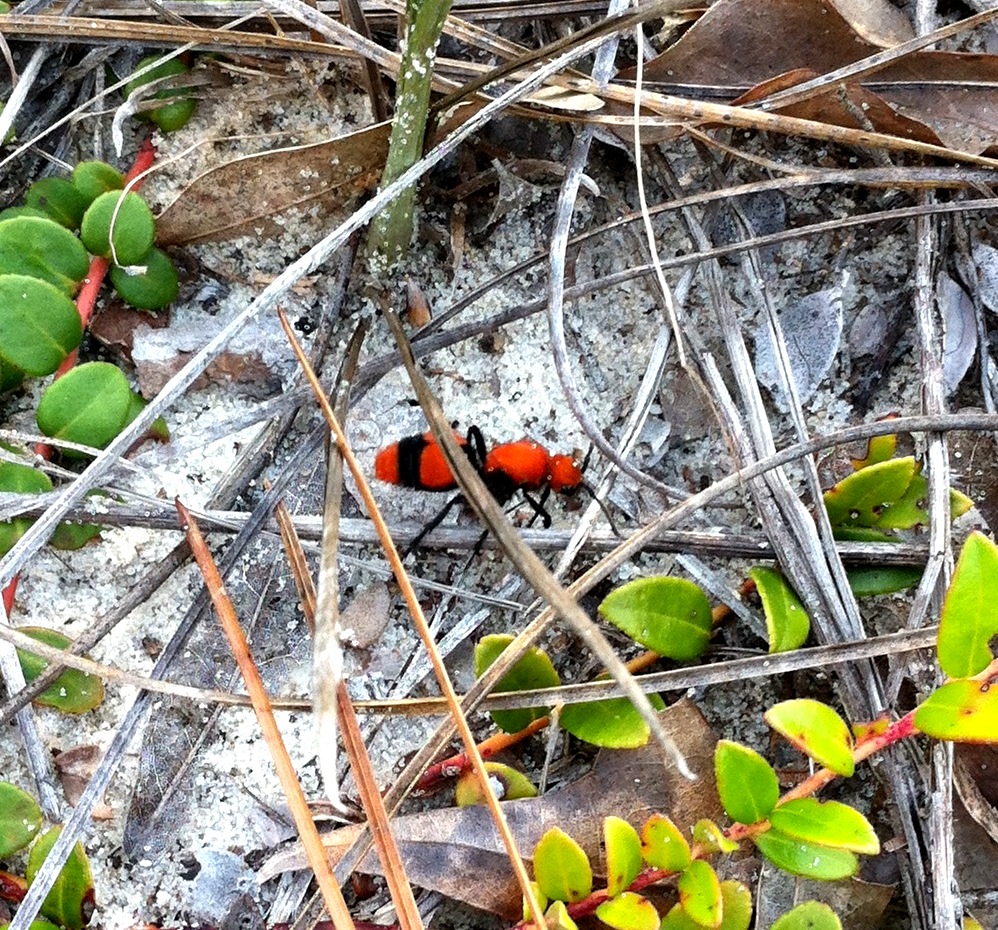 Beware the velvet ant which we have been seeing many of in recent weeks here on the Crystal Coast of North Carolina! Velvet ants, despite their title, aren’t actually ants at all but solitary wasps in the family Mutillidae. These wasps are covered with dense hairs giving them a velvety appearance, hence the name. Velvet ant females are often encountered in open, sandy areas within pasture and turf settings where their larval hosts, ground nesting bees and wasps, are likely to be found. After hunting out underground host nests, the wingless female lays an egg within the larval chamber or on the host larva itself. Upon hatching, the immature velvet ant feeds and develops on the host larva eventually consuming it. The best way to purge an area of unwanted velvet ants is to exclude the ground nesting bees and wasps they are parasitic on. The preferred method is to discourage initial colonization by maintaining a lush, thick turf stand.
As an interesting side note these wasps are often referred to as “Cow Killers” because their sting is alleged to be so painful it could kill a cow! Entomologists developing a sting pain scale ranked the Velvet wasp sting a 3.0 out of a possible 4 (traumatically painful). In this case a 3.0 indicated a “sharply and seriously painful” sting. I think I’ll take their word for it! Fire ants were ranked at a meager 1 for those of you familiar with their sting.
Velvet ants exhibit aposematic or “warning” coloration. Remember when you see an animal that has a combination of yellow and back or red and black it is best to leave them alone!
 parkerbiolabs.com